Blogs and content sites
Make clear that articles are general information, not professional advice for the reader's situation.
Limit what the information you publish is promising — including third-party links — while leaving the rights you cannot exclude intact.
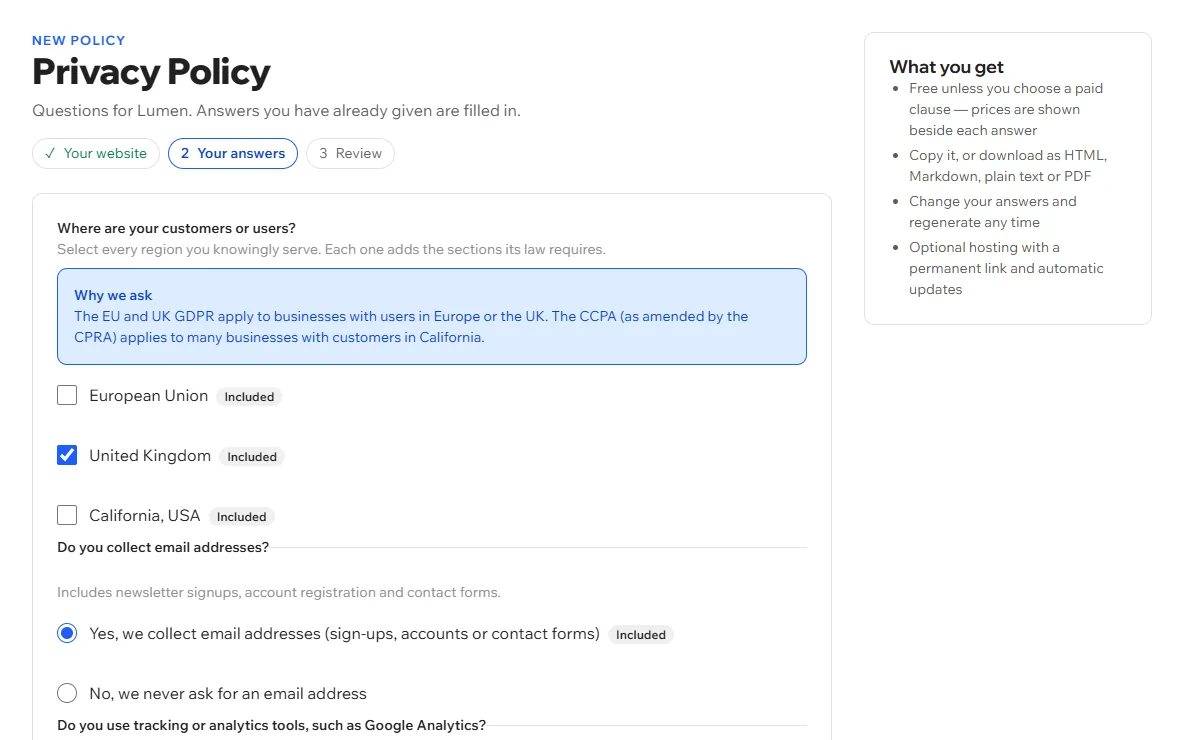
Answer in plain language and your disclaimer is assembled from them.
Clauses appear when your answers switch them on, including EU, UK and California wording where a policy has it.
Plain-language hints on the questions, and a note wherever the law makes an answer matter.
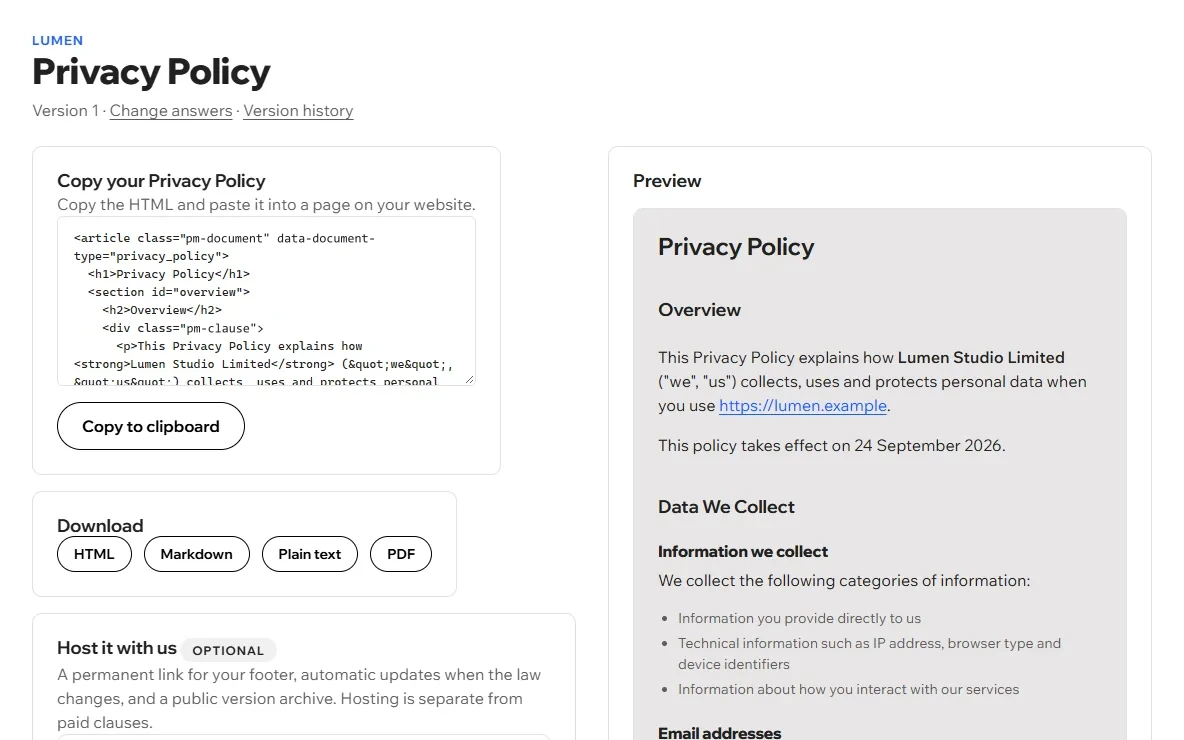
HTML, Markdown, plain text or PDF, free. Hosting at a permanent link is optional.
There is no master template with blanks. Each section is built from the clauses your answers switch on — a clause that does not apply to you is simply not there.
Make clear that articles are general information, not professional advice for the reader's situation.
Explain that you do not control third-party sites and are not responsible for their content.
Set expectations about accuracy and how the information should — and should not — be relied on.
Privacy policy, terms, cookie policy, refunds and more. You answer only the questions that policy needs.
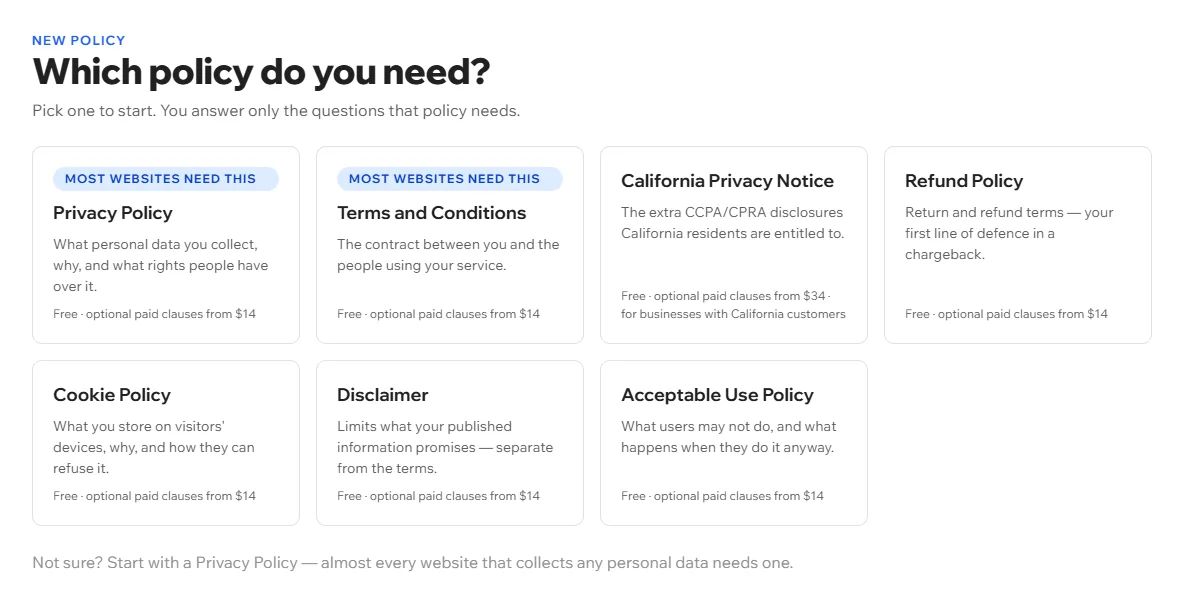
Plain questions about your business, with a note on why each one matters. Any paid clause shows its price beside the answer.
Copy the HTML, or download HTML, Markdown, text, PDF or Word. A policy with paid clauses can also be hosted at a permanent link that is updated for you.
They do different jobs. Terms govern the use of your service; a disclaimer limits what the information you publish promises. Content-heavy sites often publish both.
No, and the generated disclaimer does not pretend to: some rights cannot be excluded by law, so it preserves them.
Yes. Creating, copying and downloading your disclaimer is free. A few specialist clauses — payments, user-generated content, affiliate links, medical information, fitness and nutrition, advertising, sponsored reviews, gdpr wording (european union), uk gdpr wording, ccpa/cpra wording (california) — are paid, from $14, and only if your answers need them. Prices are shown next to each answer before you pay.
Not for a free policy — you can create one as a guest. An account is needed to pay for clauses, to host a policy, or to come back and edit it later.
Yes. Copy the HTML into a page on your site, or download it as HTML, Markdown, plain text or PDF.
Yes, once it includes a paid clause: a paid policy can be hosted at a permanent URL you link from your footer, and is updated for you when its clauses are revised. Every published version is kept. Free policies are copied or downloaded.
No. Policy Monster is not a law firm and does not give legal advice. The generator assembles a document from your answers; for advice about your own situation, speak to a qualified lawyer.
What cookies are, when consent may be required, and what a fair banner usually includes.

How to map what your site really collects and describe it truthfully in your policy.

The policies most online shops publish, what each covers, and where to show them.
Free to create, copy and download. No account needed. Paid clauses come with hosting.
Create it nowChoices stay in this browser. Accessibility statement